Tutor Intelligence raises Series B to scale model training, robot deployments
Tutor Intelligence has raised funding to further develop its picking robots, networked intelligence, and commercial deployments. The post Tutor Intelligence raises Series B to scale model training, robot deployments appeared first on The Robot Report .
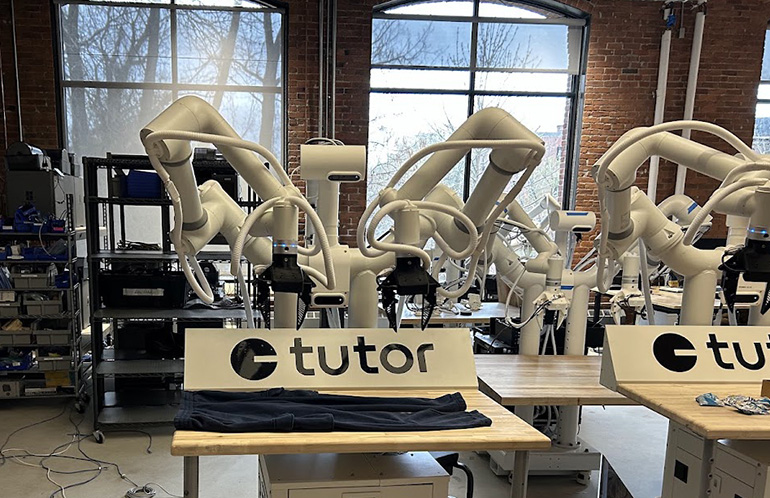
Tutor trains its Sonny robot on real-world manipulation tasks. Credit: Eugene Demaitre Real-world data, human “tutors,” and simulation are all part of the recipe for training AI models to enable next-generation robots to tackle a widening variety of tasks. Tutor Intelligence Inc. today said it has raised $75 million in Series B funding as it works toward general-purpose robotics. “It’s not only that Tutor’s models let robots do jobs that robots have never been able to do before,” stated Josh Gruenstein, co-founder and CEO of Tutor Intelligence. “This type of intelligence also makes robots affordable on a whole new level. We’re unlocking much broader access to the solutions that businesses need to survive and that make basic goods cheaper for everybody. And the demand is there. We can hardly build robots fast enough.” Tutor Intelligence spun out of the Massachusetts Institute of Technology Computer Science and Artificial Intelligence Laboratory ( MIT CSAIL ) in 2021. The Watertown, Mass.-based company asserted that it is building a full technology stack to “close the gap between what robots can do and what people can do.” Data flywheel accelerates robot deployment “Artificial intelligence has transformed the digital world, learning to converse and code from the internet’s vast record of text and images,” said Tutor Intelligence. “The physical world has no such record to train on, and AI has yet to transform it in the same way.” The company has deployed fleets of internet-connected robots into production environments, where they do real work for customers with input from remote operators known as “tutors.” It uses the real-world data to train better frontier models, ultimately making the robots more capable. Tutor claimed that its “full-stack platform” and “data flywheel” accelerate deployment, making robots more scalable, safer, and more affordable. Instead of a robots-as-a-service ( RaaS ) model, business pay Tutor by the hour or by the pick, the same way they pay for manual labor. Customers make no upfront purchase and sign no long-term contract, added Tutor. The company said it handles deployment and maintenance and regularly sends software and intelligence upgrades. Tutor said its approach is bringing automation to tasks that have long defied conventional, deterministic robotics. It opened a “ Data Factory ” earlier this year to evaluate policies across 100 physical robots. Submit your innovation now! Tutor Intelligence gets traction with Sonny and Cassie Tutor’s Data Factory includes the Sonny two-armed, semi-humanoid robots for each picking. Cassie is a mobile manipulator designed for case picking and palletizing . The company reported that twice as many of its robots are working in almost four times as many facilities as a year ago. It said it is on track to have more than 1,000 robots under contract by the end of 2027, all of which will be built in and deployed from the U.S. (The tutors may be overseas.) The robots are currently moving, lifting, and manipulating objects across some of the country’s largest manufacturing and logistics networks. They handle breakfast cereals, snacks, candy, cosmetics, home goods, toys, and more. Tutor noted that its growth reflects maturing enterprise adoption of physical AI, as companies move from pilots to expectations of a return on investment from automating their operations. Nearly a third of organizations that received Tutor robots in the past 12 months were existing customers installing more robots, it said. Funding to support more training and manufacturing Andreessen Horowitz led Tutor Intelligence’s Series B round, which brings its total capital raised to $117 million. Union Square Ventures and Neo, which led the company’s Series A and seed rounds, respectively, also participated. “Tutor’s insight is that deployment isn’t just the destination for robotics research—it’s how you overcome its limitations,” said Raghu Raghuram, general partner at Andreessen Horowitz and former CEO of VMware. “Rather than asking the real world to fit the research, Tutor starts with what real-world deployments demand and works backward through distribution, hardware and research,” he added . “Continual learning across an expanding range of deployments is the path from specialized capabilities to general-purpose robotics.” Tutor said its latest investment its frontier robot foundation model training, as well as manufacturing and deployment of Sonny and Cassie. It announced the latest models of its robots and underlying platform last month. The post Tutor Intelligence raises Series B to scale model training, robot deployments appeared first on The Robot Report .