Unusual robotic animals can prove their utility
Robotic animals are designed to be helpful rather than scary, showing promise in disaster recovery, utility inspection, and companionship. The post Unusual robotic animals can prove their utility appeared first on The Robot Report .
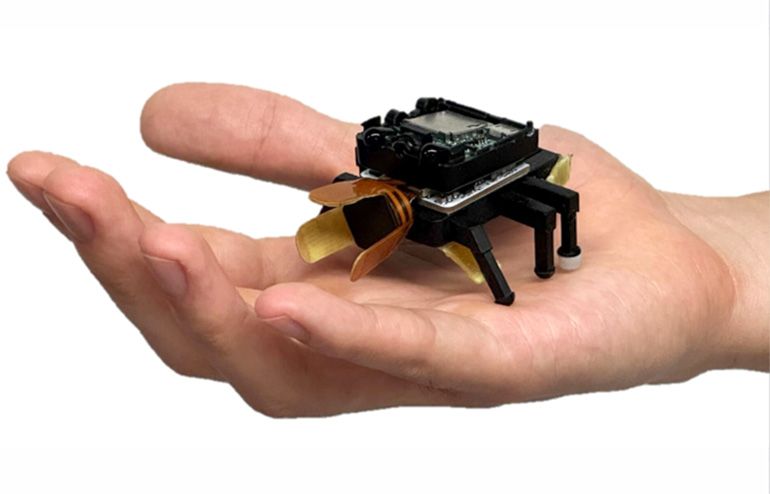
Korean researchers have developed a beetle-like soft robot. Source: KAIST When we hear the word “robot,” we still conjure up images of mechanical figures from old science fiction films. However, reality has long since evolved: We’re surrounded by smart vacuum cleaners, voice assistants, and even four-legged machines that mimic dogs. But what are these robotic animals? They’re not just battery-powered toys. They’re complex electronic devices, infused with elements of artificial intelligence, that replicate the appearance and behavior of real or imaginary creatures. These devices contain sensors , speakers, motors , and processor modules that analyze external signals. They’re controlled via mobile apps. Digital pets can make distinctive sounds, respond to signs of affection, answer to their names, and display a range of emotions—from delight to fear, from satisfaction to fatigue. Manufacturers employ a variety of engineering approaches when creating these devices. Let’s look at some interesting examples. Microrobot beetle and its relatives A microrobot beetle might seem like a fun little gadget. But leading research centers such as the Korea Advanced Institute of Science and Technology ( KAIST ) are working on developing similar insects (see image above). So why are robot ants, robot beetles, and robot bees being created? The answer lies in solving practical and even humanitarian problems. Cyborg cockroaches: Rescuers from under the ruins In the spring of 2022, a tragedy occurred in the city of Changsha, China—a six-story building collapsed. Dozens of people were trapped under the rubble. Many remained missing for nearly six days. Rescue efforts were hampered by piles of rubble and collapsed floors. Ultimately, 53 people died, and only 10 were rescued. In such operations, every minute is precious. Rescuers use thermal imaging cameras and comb through the rubble, but this takes precious time. But what if cockroaches come to the rescue ? These insects are fast and can penetrate even the tiniest cracks, allowing them to quickly survey the disaster area. But how can they be made to search for people? A team at Nanyang Technological University ( NTU ) in Singapore said it has found a solution by transforming a Madagascar cockroach into a cyborg. A miniature backpack containing a microcomputer is attached to the insect’s back. It contains sensors that detect dangerous gas concentrations, as well as an infrared camera with a thermal imager, allowing it to detect bodies under the rubble. To prevent the insects from scattering randomly, but rather to remain confined to a specific area, the scientists have developed a remote control system. Electrodes and a microchip are attached to the cockroach’s body. An electrical impulse to the right side causes the insect to move to the left, and vice versa. When both electrodes are activated, the cockroach accelerates and runs straight. This cyborg can operate for long periods in rubble: the microcomputer is powered by solar panels. One individual can survey an area of up to 100 sq. m (1,076.3 sq. ft.). The operator controls the movement and monitors the signals from the sensors. However, there’s a catch: to fully survey a large building, about 500 of these cockroaches are required, meaning 500 operators. And although the cyborg will indicate the location of the victim, it won’t be able to extract them—that’s a task for humans. Robot ants: Strength in miniature Stanford University engineers created mechanical ants capable of moving loads 2,000 times their own mass. For a human, this is the equivalent of moving a 150-ton whale. Just four of these tiny animals can transport an adult, and a whole group can lift a concrete slab or rebar. This phenomenal lifting capacity was achieved thanks to a gecko-inspired paw design that provides a secure grip on any surface. A special coating of microscopic rubber hairs creates a bio-stimulated adhesive effect: When the rope is taut, the robot adheres and releases when it is loosened. However, this high performance requires a lot of energy. The battery can run out at critical moments, so in industrial settings, these ants are connected to a cable and used as towing vehicles. Snake-like robot: Underwater repairman Animal robots are capable of not only eliminating the consequences of disasters but also preventing them. Norwegian developers have created a 5 m (16.4 ft.) robotic snake for servicing underwater oil pipelines. It inspects pipelines, transmits images to a dispatcher, and, if a defect is detected, repairs it. Equipped with manipulators at both ends, the snake can replace valves and clean deposits from pipes. These devices can operate at depths of up to 500 m (1,640.4 ft.) for up to six months, recharging at special stations. Robot crab: Underground explorer University of California, Berkeley , engineers developed a robotic crab for underground exploration. Using fabric scoops on its claws, it burrows into the ground, collects samples, and analyzes the soil. Equipped with sensors and a manipulator, it can determine the suitability of a site. These robotic animals could be used in construction or agriculture , detecting pollution. In the future, such crabs are even planned for use on the Moon. Scientists are currently working on improving the design so that the robot can dig deeper. More recently, open-source crab platforms are helping developers innovate locomotion. Robot falcons: Airfield guardians Mechanical falcons, developed at the University of Groningen in the Netherlands, are already in service in Canada and Germany. They frighten real birds away from runways, preventing collisions that could lead to plane crashes. Unlike acoustic cannons, which birds quickly become accustomed to, robotic predators exploit natural fear—they not only mimic predators but also pursue live birds, demonstrating dominance. Robot bee: Space scout A miniature robotic bee, the size of a pinhead, was created at Harvard University . Although it can theoretically pollinate plants, its true purpose is reconnaissance. Sensors mimic the vision and antennae of insects and transmit a three-dimensional image to the operator. This micro-reconnaissance vehicle can fly, swim, and dive. It runs on solar batteries, consuming only 120 milliwatts—less than a light bulb. Scientists are confident that these bees will be useful for exploring Martian canals, lunar craters, and even the toxic clouds of Venus. A variety of zoomorphic robots emerges Today, numerous robots mimic the behavior of a wide variety of animals. Their advantage is the ability to move horizontally and vertically, navigate obstacles, and penetrate hard-to-reach places. Unlike real animals or people, they do not require food or water, making them suitable assistants in deserts, mountains, and the exploration of other planets. They could be indispensable in rescue operations and scientific research. For example, MIT scientists created Mini Cheetah—a platform used to test algorithms for guide robots and jumping machines. Chinese engineers have developed an insect-sized model that has the properties of spiders and cockroaches. Another robotic cheetah from DARPA reached speeds of up to 18 mph . A flexible robot, modeled after the Caenorhabditis elegans roundworm, was capable of navigating around obstacles. Gecko Robotics has commercially deployed systems equipped with suction cups for vertical movement and can operate in hazardous environments. Submit your innovation now! Quadrupeds follow dogs as human companions Some four- legged robots can travel over 30 km (18.6 mi.) without recharging and carry loads of up to 180 kg (396.8 lb.). They can transport the injured and recognize voice commands. Three years ago, Moscow State University unveiled the first such robot in Eastern Europe, costing approximately 1.5 million rubles. The Unitree Robotics A1 model, weighing 15 kg (33 lb.), was controlled by powerful electric motors. It was even tested at a zoo to