AGIBOT introduces Worken to measure robot productivity at AGIBOT Innovation Day 2026
AGIBOT unveiled its AHA3 integrated platform, GO-3 Preview, and WITA-Omni 1.0 model, as well as the G2 Max robot and Link-U OS 1.0 framework. The post AGIBOT introduces Worken to measure robot productivity at AGIBOT Innovation Day 2026 appeared first on The Robot Report .
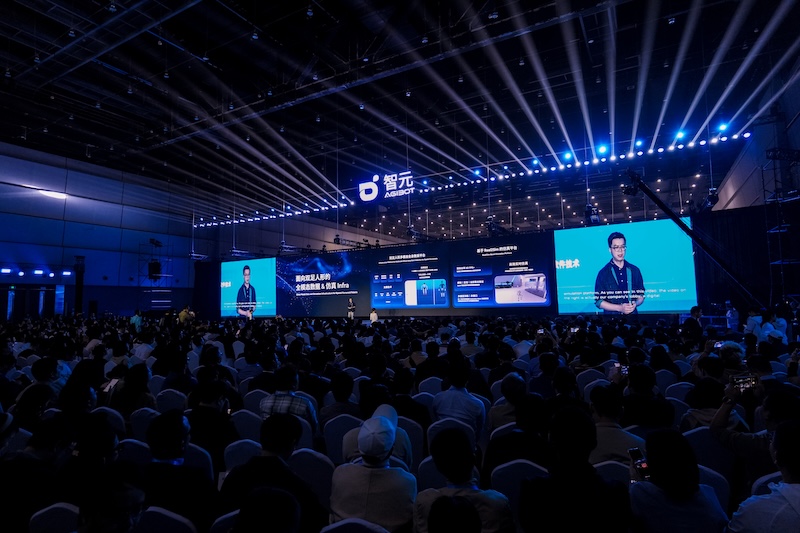
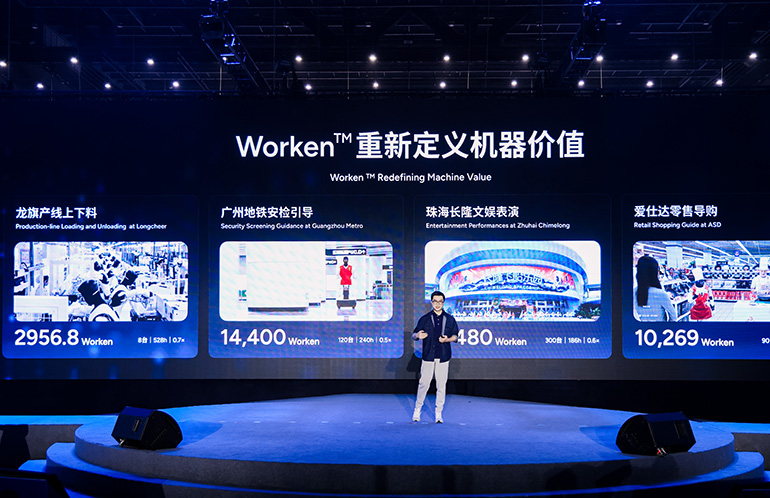
Peng Zhihui, president, CTO, and director of AGIBOT, introduces Worken at AGIBOT Innovation Day 2026. Source: AGIBOT AGIBOT today introduced Worken, a proposed framework for measuring the productivity of robots in real-world environments, at AGIBOT Innovation Day 2026 in Shanghai. Combining the words “Work” and “Token,” the concept seeks to shift attention beyond the number of robots manufactured or deployed toward how much useful work they can perform autonomously and consistently. The company also unveiled AHA3, its integrated “three intelligences in one” hardware platform, and highlighted advances in its AGILE motion intelligence framework, including a new self-evolving agent capability. AGIBOT debuted GO-3 Preview, its next-generation embodied AI foundation model, showcased its WITA-Omni 1.0 omni-modal interaction model, and launched the G2 Max industrial robot and Link-U OS 1.0. The event also featured actual applications across manufacturing and commercial services, demonstrating AGIBOT’s focus on translating robotics innovation into productive work. The company said they reflect its deployment-first focus, with practical innovation spanning robot hardware, locomotion, task and interaction intelligence, operations, and an ecosystem intended to support real-world deployment at scale. Founded in 2023 as Zhiyuan Xinchuang Technology Co., AGIBOT is focused on embodied AI. The Shanghai-based company ‘s portfolio spans humanoid robots, quadrupeds , dexterous systems, and commercial cleaning systems. Last month, AGIBOT said its 20,000th robot had rolled off the production line, and IDC reported that the company led global humanoid robot shipments in the first half of 2026. Submit your innovation now! Worken is a proposed measure of robot productivity As robots move from large-scale production into increasingly diverse applications, AGIBOT said there is another dimension of progress: the productive work robots can deliver once deployed. In addition to manufacturing scale, technological capabilities, and deployment milestones, the company said sustained autonomous operation and measurable task output are increasingly important indicators of robotic value. “Over the past few years, the robotics industry has made remarkable progress in hardware, AI models, and large-scale manufacturing,” stated Peng Zhihui, co-founder, president, and chief technology officer of AGIBOT. “But as robots begin working in factories, warehouses, and service environments, we need to answer a more practical question: How much productive work are they actually delivering?” “Worken is our attempt to develop a new way of answering that question,” he added. “We want to move beyond measuring how many robots are built or delivered and begin measuring how effectively they can perform useful work, autonomously and consistently, in the real world.” Even deployments involving similar numbers of robots can deliver different levels of productivity, depending on how independently the machines operate, how frequently human intervention is required and how much acceptable work they complete. AGIBOT described Worken as “effective intelligent work hours,” bringing three factors into a proposed measurement framework: Worken = Number of Active Robots × Autonomous Working Hours × Output Efficiency Ratio The first factor counts robots actively performing tasks in real-world environments, rather than units simply manufactured or held in inventory. The second measures time spent working autonomously, rather than total powered-on time. The third factor assesses productive output against a reference benchmark for a defined task, such as the amount of acceptable work completed by a human worker under established operating standards. The Worken framework combines the number of active robots, autonomous working hours, and an output efficiency ratio to measure robot productivity in real-world deployments. Source: AGIBOT By connecting deployment scale, autonomy, and task output in Worken, AGIBOT said it wants to provide a more comprehensive way to describe robotic productivity across applications such as industrial handling, logistics, inspection, and commercial services. “The concept also opens up a broader discussion about the economics of robotics,” said the company. “While hardware depreciates over time, improvements in software and AI models may enable the same machine to perform more useful work during its operating life. Measuring that output alongside total lifecycle costs could help businesses evaluate the longer-term value of robotic deployments.” AGIBOT said Worken is an evolving framework that will be further refined through deployments and operational data. By developing task-specific benchmarks and accumulating practical experience across different applications, the company said it hopes that Worken can serve as a widely applicable reference for measuring the productive value of physical AI. The event also featured the release of the “2026 Embodied Intelligence Industry Innovation Report,” which discussed the industry’s progress toward real-world deployment. Jointly compiled by China Economic Information Service and the Shanghai Industrial Innovation Center of the China Academy of Information and Communications Technology ( CAICT ), the report included Worken and AGIBOT’s deployment examples as part of its industry analysis. AGIBOT unveils AHA3 platform and new physical AI models The AGIBOT Humanoid Architecture, or AHA3, which unifies “three intelligences in one” — locomotion, interaction, and manipulation Intelligence — in an embodied AI system. The company said it designed the third-generation hardware architecture to improve efficiency. Built on advances in motor- drive technology, integrated computing , and high-speed connectivity including Wi-Fi 6 and 5G, the AHA3 is designed to reduce integration complexity, improve system responsiveness, and support more capable robots in industrial applications. To support sustained industrial deployment, AGIBOT also introduced a joint liquid-cooling system intended to improve thermal performance during continuous operation, alongside specialized joints with IP67-rated protection for more demanding environments. Zhihui shows a hardware component of the AHA3 platform at AGIBOT Innovation Day 2026. AGILE advances locomotion AGIBOT showed advances in its AGILE “multimodal, end-to-end locomotion intelligence” framework. The architecture spans general-purpose motion foundation models, generative motion control , integrated whole-body perception and control, and a newly introduced self-evolving agent capability. AGILE is designed to enable robots to explore the boundaries of their physical capabilities and progressively improve their performance through experience, extending motion intelligence beyond predefined behaviors toward greater autonomy and adaptability. AGIBOT described the framework as “a shift from motion control toward spatial mobility intelligence, with the goal of helping robots adapt to the layouts and changing conditions of real deployment sites.” A demonstration of task execution with GO-3 Preview, an embodied AI foundation model integrating reasoning, prediction, and action. Source: AGIBOT MEgo Glove and OmniHand get hands-on experience On the data side, AGIBOT introduced MEgo Glove, a wearable tactile data-collection device designed to capture human hand movements and contact information for training embodied AI models. Offered in Air and Ultra versions, the glove supports finger-pose capture, while the Ultra version adds three-dimensional fingertip and palm force data and torque information. The system is intended to help turn hands-on work experience into training data that can support robots after deployment. In addition, AGIBOT’s new dexterous hand family includes OmniHand 3 Lite, OmniHand 3 and OmniHand 3 Ultra, as well as the OmniPicker 3 tactile gripper , expanding the options for fine manipulation and task-specific deployment. Th