How to study a swiftly melting climate disaster
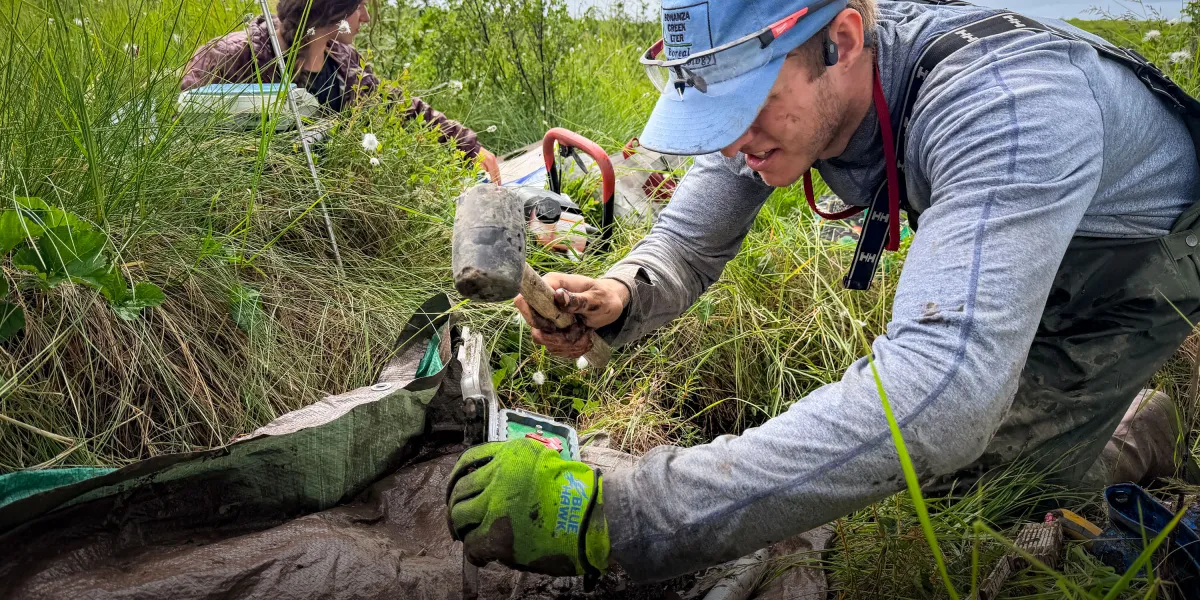
Andrew Haverdink, a tall grad student in a rain bib and rubber boots, wrenched a double-handed drill from the frozen soil that underlies much of Alaska’s Denali National Park and then unclipped the hollow barrel from the end of the bit. He knelt in front of a blue tarp, lined the barrel up with a…
Andrew Haverdink, a tall grad student in a rain bib and rubber boots, wrenched a double-handed drill from the frozen soil that underlies much of Alaska’s Denali National Park and then unclipped the hollow barrel from the end of the bit. He knelt in front of a blue tarp, lined the barrel up with a plastic tray, and pushed a rod through the opposite end. A perfect solid, cylindrical core of ancient soil emerged—dark, rich permafrost at least a foot long. On that late morning in early July, Haverdink was among a team of Northern Arizona University students and staff gathering samples and data from a research plot, divided by surveyor’s tape unspooled atop tussocks, alders, and fireweed. In late June of 2013, a lightning strike sparked a fire in this stretch of mostly treeless tundra, in the northern backcountry of the park. Whipped by the Chinooks , intense downslope winds created as moist ocean air surmounts and then descends the Alaska Range , the fire ripped across nearly 35,000 acres . It burned through much of the vegetation and deep into the topsoil, stripping away the insulating layer that preserves the frozen permafrost, a massive storehouse of carbon that underlies 85% of Alaska. During their first survey, in 2016, the researchers found that in places where the fire burned hottest and deepest, the thawed soil above the permafrost (known as the active layer) extended between a foot and nearly two feet deeper than in plots outside the burn scar—an indication of deep thawing. Northern Arizona University graduate student Andrew Haverdink drills out permafrost cores in the northern backcountry of Alaska’s Denali National Park. JAMES TEMPLE Crucially, the fire also crossed two sets of survey grids that the National Park Service established in 2001, including the one where the researchers stood that morning. That pre-fire snapshot offered the Northern Arizona group a rare opportunity to study how the blaze has altered the vegetation, carbon, and permafrost across time, says Xanthe Walker, one of the principal investigators on the project, who was watching over Haverdink’s work that morning. These direct observations from high-latitude fires are helping scientists to better understand the impacts of wildfire and permafrost loss on climate change, she says. “There’s a lot of uncertainty,” Walker says. “These are huge biomes with massive fires that no one’s ever been to or ever looked at.” They’re among a growing group of researchers striving to untangle what happens in the aftermath of fires in the Arctic-boreal region as they occur more often, burn hotter than before, and expose the landscape and frozen permafrost to a warming climate. The work is providing critical clues into the complex mechanisms driving cascading climate feedback effects: As warming temperatures fuel more frequent and severe fires, more permafrost thaws, releasing greenhouse-gas emissions that threaten to fuel more warming, fires, and permafrost loss . Understanding just how powerful these effects are, how they compound, and to what degree other transformations of the landscape may mitigate them is essential to gain a clearer picture of our climate future. Notably, past modeling suggested that the carbon dioxide uptake from expanding trees and plants may largely offset the release of carbon from warming soils and melting permafrost, at least over long periods and under moderate levels of warming. But the improving observations and analyses have revealed worrisome signs about the impacts of rising Arctic-boreal emissions in the immediate decades ahead, as the world struggles to keep global warming within relatively safe boundaries. The permafrost problem Permafrost makes up 15% of the land surface of the Northern Hemisphere and holds about 1.5 trillion tons of carbon, roughly twice the amount in the atmosphere. Most of it formed during the last ice age, but it’s been thawing at an accelerating rate during the last half-century, amid rising temperatures and worsening fires. As it melts, microbes begin to break down that organic matter, releasing it into the air in the form of carbon dioxide and methane. Both are powerful greenhouse gases that fuel climate change. The impacts of permafrost loss, however, aren’t as straightforward as they may initially seem. Notably, there has been a long-running scientific debate over what would have the strongest effect on the exchange of greenhouse gases over the next few centuries: the loss of carbon in soil and permafrost or the carbon uptake from so-called “Arctic greening,” which describes the spread of carbon-absorbing plants across the landscape as temperatures rise. Thawing permafrost itself can contribute to the latter phenomenon as the unfrozen soil layer deepens and makes more nitrogen, phosphorus, and other nutrients accessible to plants. Carbon-sucking trees and shrubs with deeper root systems can take hold and thrive in places where they wouldn’t have been able to in the past. A riverbank exposes ice-rich yedoma permafrost along the Itkillik River in northern Alaska. MIKHAIL KANEVSKIY; UNIVERSITY OF ALASKA FAIRBANKS But as more Arctic-boreal fires ignite and more permafrost melts, researchers have been able to closely study what exactly happens in the aftermath, using on-site surveys like those conducted by the Northern Arizona University team, satellite observations, lidar flights, a widening network of greenhouse-gas-measuring towers, and other tools. The findings have alarmed many researchers. In particular, permafrost seems particularly prone to abrupt thawing rather than the gradual version that major climate models have simulated. A 2020 paper found that this could release far more carbon than previously understood, doubling the emissions from thawing permafrost and offsetting the carbon uptake from future plant growth. In addition, even if carbon levels eventually net out through Arctic greening, the emissions from high-latitude fires and permafrost loss appear to be accelerating warming right now. Susan Natali, an Arctic climate scientist at the Woodwell Climate Research Center, and her colleagues have published several papers in recent years concluding that the combined emissions from these feedback effects will push the planet past 2 °C faster than currently predicted. She and other researchers also found that about 40% of the Arctic-boreal zone has already flipped from a carbon sink into a carbon source, when the emissions from permafrost melting, fires and other forces are taken into account. “The more we learn about processes like abrupt thaw, deeper-burning fires, and cold-season emissions, and the more we see disturbances increasing, the more likely it is that the sink will weaken and source areas will expand,” Natali said in an email. But there’s still considerable uncertainty about the differences between the ways fires and thawing permafrost might alter landscapes, under different circumstances in different biomes. “This is just a challenge of the science, because it’s really hard to measure such a huge area, which is not one system,” she says. “It’s many, many, many, many different types of ecosystems.” Results may vary The Northern Arizona University researchers have been at the forefront of efforts to study the aftermath of intensifying fires across different parts of Alaska. Over the last two decades, Michelle Mack, a professor of ecosystem ecology who was previously Walker’s postdoctoral advisor, has overseen repeat survey work on fire sites across forests and tundras, from the relatively warm southern interior to the frigid North Slope. Michelle Mack, a professor of ecosystem ecology at Northern Arizona University, has overseen post-fire surveys across Alaska. MATT ‘MARTIAN’ WILLIAMS Her husband and frequent collaborator, Ted Schuur, is also a professor at the university and oversees several permafrost monitoring and experimental research sites at the Eight Mile Lake study area, just north of Denali National Pa