The US military’s race to make fake blood
Its call sign was Morphine 1-2. In February 2007, the hulking dual-rotor casualty evacuation helicopter had just flown three wounded soldiers to a field hospital in Balad, north of Baghdad, when another call came: an emergency mission to fly through an insurgent-controlled area in broad daylight. Typically, helicopters would be in a spot like…
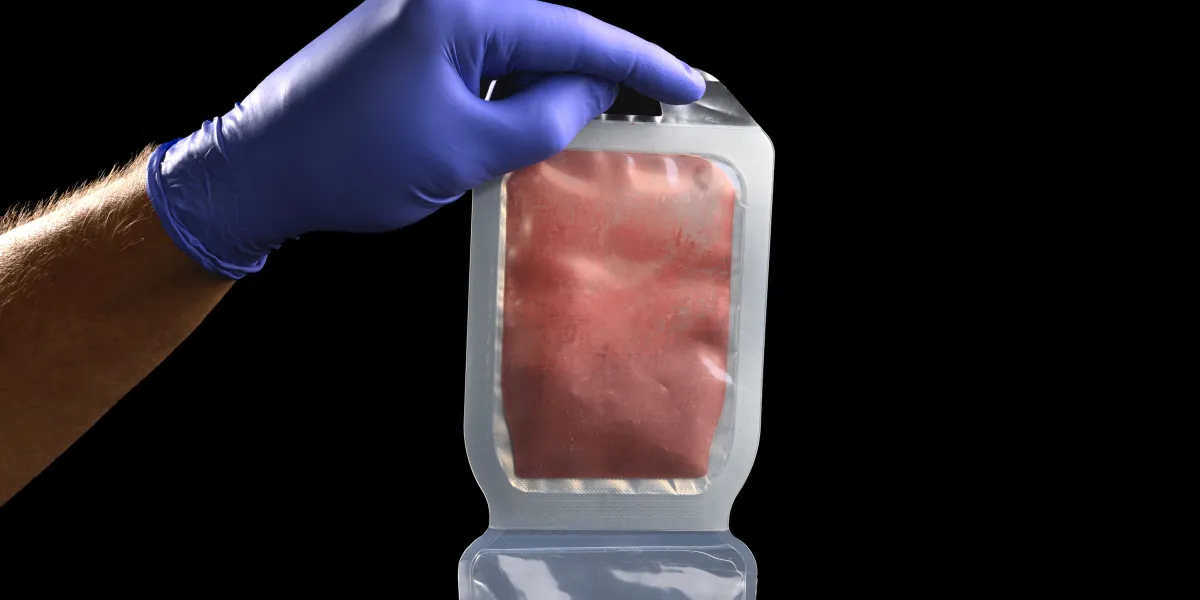
Its call sign was Morphine 1-2. In February 2007, the hulking dual-rotor casualty evacuation helicopter had just flown three wounded soldiers to a field hospital in Balad, north of Baghdad, when another call came: an emergency mission to fly through an insurgent-controlled area in broad daylight. Typically, helicopters would be in a spot like this only at night, and with all lights turned off. As it passed near the city of Karmah, in the eastern side of Al-Anbar province, an insurgent fired a portable missile launcher. The tail gunner, who likely saw the shot roaring in, yelled for the pilot to make an evasive move. But the missile had already locked on, and the ensuing blast started a fire on board. After the pilot battled the failing machine for 58 agonizing seconds, Morphine 1-2 plunged to the ground. All seven crew members were killed. Why was the helo there in daylight? “It was getting blood and bringing it back. It was [on] what we call a ‘blood run,’ and [it’s] the highest of priorities besides casualty evacuation,” explains Lieutenant Commander Robert Murray, a Navy officer and program manager at DARPA, the Defense Advanced Research Projects Agency, who studied this incident as an intelligence officer. Today, a chronic shortage of blood in both the military and civilian worlds is fueling a race to develop synthetic alternatives. About 90% of preventable battlefield deaths are due to hemorrhage—bleeding that happens when a blood vessel ruptures—and it’s the leading cause of maternal deaths worldwide. A study published in Transfusion in 2025 found that of 1.2 million trauma patients in the United States who potentially needed blood before reaching a hospital, just 1% received it. The shortage results in about 10,000 preventable deaths each year in the US, according to the American College of Surgeons. Globally, that figure is likely in the millions . One reason for the shortfall is that blood has a storage problem. Whole blood lasts only 35 days when refrigerated, so banks separate out components to stretch the timeline. But that’s an imperfect solution. The platelets that help wounds clot are typically stored at room temperature and last for a week or less. Hospitals and the military freeze the red blood cells that carry oxygen, as well as the protein-rich plasma that restores volume and aids coagulation. Once thawed, though, both will spoil within days. “What happens if I don’t know when I’m going to be attacked? Well, thaw it and you let it expire, right?” Murray says. A JAMA study of combat injuries in Afghanistan suggests a magic number for someone who needs a transfusion: You have 36 minutes to get started. That’s why Murray—who, in addition to his military experience, has a PhD in physiology—is leading a DARPA effort to address blood’s battlefield problems. He’s in charge of a new $73 million dollar program called RAPIID (for “resuscitation and prevention of ischemia-induced dysfunction”). Its goal is to create shelf-stable versions of the three major transfusion constituents: plasma, platelets, and red blood cells. As it gets underway late this year, RAPIID picks up on decades of work to synthesize blood or help it last longer. Most recently, that includes a prior $47.5 million DARPA project called FSHARP (for “fieldable solutions for hemorrhage with bio-artificial resuscitation products”), in which researchers have demonstrated promising results in animals. KaloCyte techs use a device called a tangential flow filtration machine to process unencapsulated hemoglobin. MATT ROTH After processing, the hemoglobin is concentrated and then freeze-dried to make it shelf-stable. MATT ROTH With RAPIID trials for the different components occurring in parallel, the goal is to have bags of dried blood products deployed in the field by 2029. That puts Murray in the position of a conductor coordinating an orchestra of clinical trials with the FDA, while also sourcing the paraphernalia that goes along with transfusions—everything from combat-durable storage bags to tests that could check how much artificial blood a patient already has. Getting it all done will be tough, but the military is feeling the pressure to address its shortage. Blood drives may not deliver in time after a mass-casualty event, and a JAMA study of combat injuries in Afghanistan suggests that if the injured person needs a transfusion, the magic number is 36 minutes. “If something is survivable—and generally we classify most all hemorrhage as survivable—[you’re] almost guaranteed to survive if you get the blood before that 36-minute mark,” Murray says. After that, the chance of survival “starts to drop precipitously.” In the mission to make portable, shelf-stable blood components, plasma is the low-hanging fruit. Researchers have known how to isolate and freeze-dry plasma, the yellowish liquid that makes up 55% of whole human blood, since the late 1930s. On the battlefields of World War II, its mix of water, salts, and thousands of types of proteins helped restore blood volume in wounded soldiers—and to some degree controlled bleeding. In the 1960s, the US abandoned freeze-dried plasma because it carried a risk of transmitting hepatitis to recipients from infected donors. But screening, testing, and drying techniques improved, and starting in 2010, the US military launched a yearslong effort to rebuild its capacity for producing these products. Over the past two years, the FDA has allowed two types of freeze-dried plasma to be used in emergencies by the US military—and one can even be used by civilians. As for platelets, efforts at extending their life date back to the 1950s, but they haven’t seen a ton of success. Bioengineers have, for example, attempted to attach the membranes of platelets to synthetic particles. The most successful project comes from a company called Cellphire, which freeze-dries actual human platelets. The product has shown safety and efficacy in humans in clinical trials, but its dependence on donors means it’s unclear whether this approach can scale. Red blood cells have been similarly tough to preserve or mimic. Their most critical component is hemoglobin, which carries oxygen and comes encased in a cell membrane. For more than a century, researchers have been looking for ways to deliver hemoglobin without the immunological challenges created by this exterior, including the fact that donors’ and recipients’ blood types need to be compatible. Evolutionary pressure developed that wrapper for very good reason, though: “Naked” hemoglobin tends to break down quickly in the bloodstream, and that can cause organ damage . It also scavenges nitric oxide, our body’s natural mechanism for opening up blood vessels, and causes those channels to constrict. This problem became all too clear in the 1980s and 1990s, when fears that transfusions could transmit HIV sparked interest in a class of membrane-free delivery mechanisms called hemoglobin-based oxygen carriers (HBOCs). One, named HemAssist, consisted of hemoglobin subunits linked together to avoid the rapid-breakdown problem. It had the added benefit of lasting roughly a year in cold storage (red blood cells last about 40 days)—but it didn’t solve the nitric oxide problem, so it constricted blood vessels. In a clinical trial, 24 of the 52 people who received HemAssist died, compared with eight out of 46 in the control group. The parent company terminated trials in 1998. A review of clinical studies published in JAMA in 2008 further solidified HBOCs’ fate, finding that they generally triple patients’ chances of heart attack and increase the risk of death by 30%. More recently, researchers have tried to grow red blood cells in a lab using a technology called “blood pharming,” which involves making them from progenitors known as induced pluripotent stem cells. The stumbling blocks? Cost and yield. DARPA launched a pharming initiative in 2008, using stem cells from discarded umbilical-cord blood, but was unable to get t