Ultrasound offers a scalable path to tactile intelligence for physical AI
Ultrasound sensing can provide tactile perception for robotic hands while avoiding wear and tear, says UltraSense. The post Ultrasound offers a scalable path to tactile intelligence for physical AI appeared first on The Robot Report .
لماذا يهم هذا الخبر؟
سيظهر الملخص التحليلي هنا بعد اكتمال معالجة الذكاء الاصطناعي.
سياق الخبر
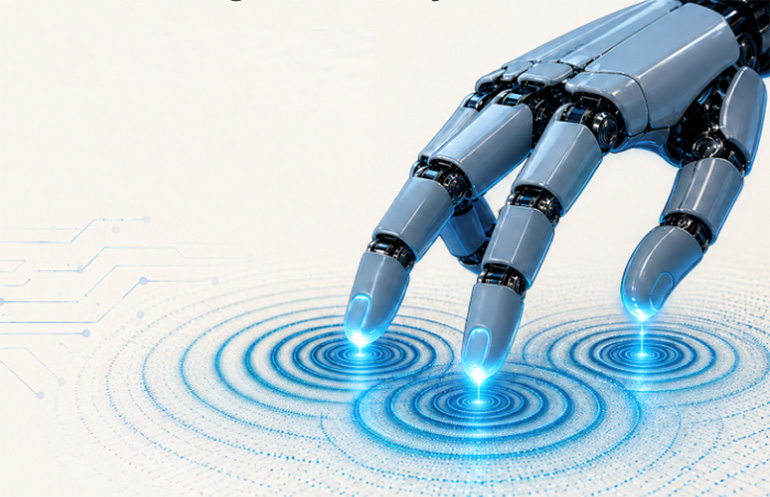
UltraSense claims that ultrasound can mitigate the wear and tear at the point of tactile sensing. Source: UltraSense Physical AI is moving from digital reasoning into real-world interaction. Robots can see, plan, navigate, and move with sophistication. Yet manipulation depends on reliable touch, creating an opportunity for ultrasound. The question is no longer whether robots need tactile sensing . For humanoid hands, dexterous grippers , logistics robots, service robots , and industrial systems, touch must detect contact, map force, sense shear and slip, and understand material interaction. The question is which tactile architecture can scale. Many tactile and electronic-skin approaches rely on flexible electrical sensing layers placed on or near the contact surface. These include capacitive, piezoresistive, piezoelectric, triboelectric, and impedance-based structures integrated into elastomers, flexible substrates, conductive networks, or multilayer films. These technologies have advanced the field. However, for high-duty-cycle robotic fingers and grippers, electronic skin faces a scaling challenge: the sensing layer is often located close to the harshest mechanical environment on the robot. That environment includes repeated compression, abrasion, contamination, humidity, temperature variation, cleaning exposure, and material aging. Even when encapsulated, a surface-coupled stack remains tied to the outer skin. Over time, that can introduce wear, hysteresis, creep, delamination, baseline drift, and recalibration burden. For a laboratory prototype, these issues may be manageable. For a commercial robotic hand operating over millions of contact cycles, they become central to product viability. UltraSense believes the better path is protected sub-surface ultrasound. Editor’s note: Physical AI is among the session topic tracks at RoboBusiness 2026, which will be on Oct. 20 and 21 in Santa Clara, Calif. Register now to attend. Register now and help us celebrate 20 years of RoboBusiness! The scaling problem with surface-coupled electronic skin A robotic fingertip repeatedly presses, slides, rubs, and impacts the world. In a humanoid hand or dexterous gripper, it must provide compliance and friction while surviving long use. This creates a tradeoff for exposed or near-surface electronic skin. If the sensing layer is close to the outer surface, it can be affected by mechanical wear. If the layer is padded for protection, spatial resolution and sensitivity can degrade. If the elastomer ages, the signal can drift. If the stack experiences repeated shear, adhesion and interlayer stability can become concerns. The issue is not visible wear; it is lifetime signal integrity. A tactile system must remain accurate, repeatable, and calibrated over time. In robotics, the sensor that works on Day 1 must still provide useful contact data after months or years. Recent advances in thin-film force sensing show that the industry is moving beyond simple single-effect sensors. Force sensing resistors can drift as conductive networks change under repeated compression, while capacitive sensors can be affected by parasitics, environment, and mechanical constraints. Newer impedance-based approaches capture broader electrical response by measuring combined resistive and capacitive behavior. This reinforces an important distinction: Reliable robotic touch needs richer information than binary contact or a single force value. However, these approaches still generally depend on a functional sensing layer in the mechanical load path. For robotic hands and grippers, that layer remains part of the wear, compression, shear, and contamination environment. The outer surface should be optimized for friction, compliance, sealing, abrasion resistance, and durability while the sensing element remains protected. That is the advantage of ultrasound. Mechanical wear is a problem for many tactile sensors. Source: UltraSense Ultrasound moves sensing below the damage zone Ultrasound enables a different tactile architecture. Instead of relying on surface electrical deformation, an ultrasound sensor can interrogate the material stack from below. Acoustic waves propagate through the structure, reflect from internal boundaries, and change in response to contact-induced deformation. When an object presses into a compliant surface, the geometry of the stack changes. Acoustic path length changes. Echo timing changes. Reflection amplitude and frequency content can change. Under shear, internal displacement and boundary conditions can shift laterally. These acoustic changes can infer what is happening at the contact interface. Ultrasound extends multi-parameter sensing into the acoustic domain. Instead of measuring only a local electrical change inside a deformable film, ultrasound analyzes the broader acoustic response of the material stack. Time-of-flight (ToF), reflection amplitude, attenuation, frequency response, phase, and acoustic impedance mismatch provide information about contact, deformation, force distribution, shear, and material interaction. This makes ultrasound a multi-parameter, not single-effect, sensor architecture. This allows sensing below the outer skin, away from direct abrasion and surface wear. The robot designer can choose an outer material — elastomer, polymer, glass, metal, leather, fabric, or another engineered surface — while ultrasound reads contact through the stack. UltraSense’s platform follows this principle: Let the outer surface handle mechanics, while ultrasound delivers tactile intelligence below the surface. Ultrasound could help avoid damage to capacitive skin. Source: UltraSense Better performance: touch, force, shear, slip, and material detection Robotic touch is not binary. A useful tactile system must provide multiple information layers. First, it must detect touch and contact location. Ultrasound can identify contact by observing how the acoustic response changes when the surface is mechanically perturbed. Second, it must provide force mapping. A single force value is not enough. A robot needs to know whether force is centered or off-axis, whether the contact patch is broad or concentrated, and whether the load is shifting. Ultrasound can infer deformation through ToF and echo changes, enabling localized force mapping. UltraSense has demonstrated ultrasound tactile sensing with 500 µm spatial resolution through an elastomer layer. At that resolution, the system can resolve fine structures, including ridge and valley patterns in a contact profile. Our company has also demonstrated localized compressive force profiling with approximately 1.25 mN precision. Third, the system must understand shear and slip. For many manipulation tasks, shear matters more than normal force. A robot may press hard enough to hold an object, but if tangential slip begins, the grasp can fail before vision detects motion. Humans use shear and micro-slip cues constantly; robots need similar feedback. UltraSense’s subsurface ultrasound approach can track lateral displacement within the material stack to infer shear-related behavior. In demonstrations, our technology has shown shear-force inference with an approximately 5 mN noise floor. Fourth, ultrasound can support material/contact classification through acoustic impedance. Every material presents a different acoustic impedance based on density and sound velocity. When ultrasound reaches the contact interface, reflected and transmitted energy changes depending on whether the object is metal, glass, plastic, rubber, fabric, skin, foam, or another soft material. By analyzing reflection amplitude, echo signature, attenuation, frequency response, and time-domain changes, the system can infer both tactile response and the acoustic nature of the surface being touched. Source: UltraSense Ultrasound offers cost-effective scaling through platform reuse To scale, tactile sensing cannot remain a custom research assembly. It must become a manufactu
فتح الخبر الأصلي