The edge AI wall: Why embodied AI requires new mathematics
Computational overload is not a bug of a specific planner, but an edge AI wall limiting physical and embodied AI. The post The edge AI wall: Why embodied AI requires new mathematics appeared first on The Robot Report .
لماذا يهم هذا الخبر؟
سيظهر الملخص التحليلي هنا بعد اكتمال معالجة الذكاء الاصطناعي.
سياق الخبر
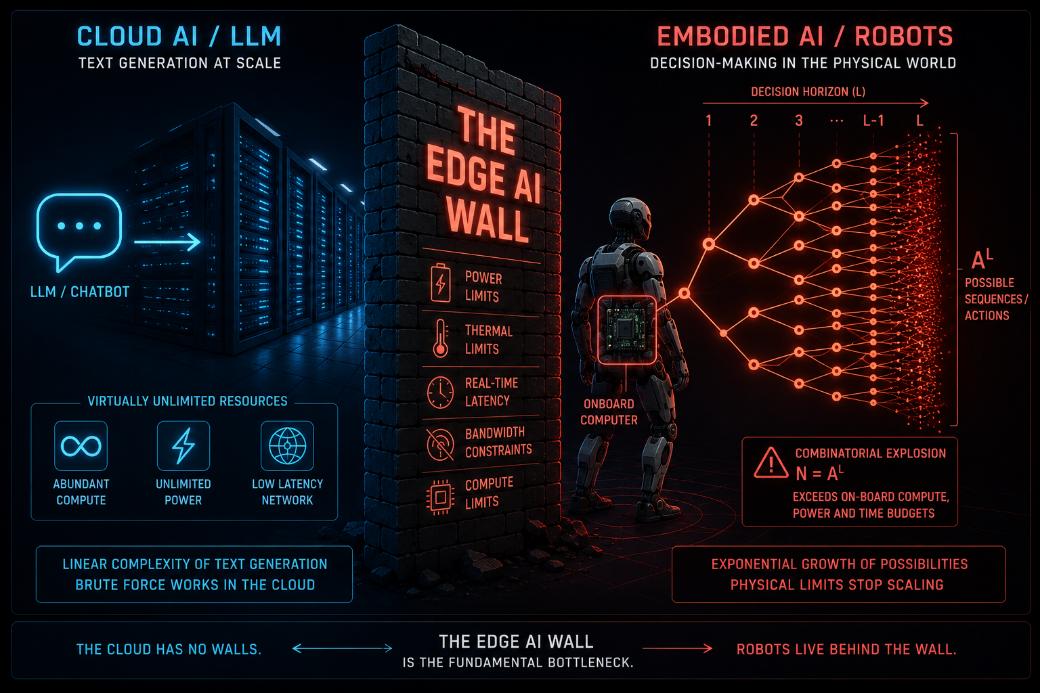
The ‘edge AI wall.’ Click here to enlarge. Credit: Zhengis Tileubay My previous article for The Robot Report examined the problem of computational instability in autonomous mobile robots, or AMRs. Since then, the rapid development of artificial intelligence over the past year has led to a broader perspective about edge AI. The article, “ Phase stability regulator based on two dynamic parameters for autonomous mobile robots ,” focused on situations in which a machine operates in a complex, rapidly changing environment characterized by a progressive growth of alternative trajectories and scenarios. In such cases, sensors , actuators , and core software may remain fully operational, yet the quality of decision-making starts to deteriorate. My main argument was that behavioral degradation often results not from hardware failure, but from an information overload within the planner, which is forced to evaluate an excessive number of alternatives in real time, leading to reduced system stability. When that article was published, this challenge appeared to be a relatively narrow problem within the local navigation of mobile platforms. However, with recent AI developments, is becoming increasingly clear that computational overload is not a localized bug of a specific planner, but a fundamental limitation common to the entire class of physical AI systems. What initially appeared to be a local failure of a navigation stack reveals itself, upon closer examination, to be a manifestation of a systemic barrier confronting the new wave of embodied AI. This article is an attempt to understand the nature of that barrier and explore mathematical pathways to overcome it. Expanding the scope: From autonomous robots to embodied AI The rapid progress of large language models (LLMs) and multimodal foundation models has pushed the industry toward a logical next step — transferring these heavy architectures directly into the physical world. This shift has given rise to a wave of ambitious projects, ranging from general-purpose humanoid robotic assistants to next-generation autonomous delivery systems and self-driving vehicles . Underlying most of these initiatives is a linear scaling hypothesis or scaling law. The implicit assumption is that if expanding computational resources and data volumes enabled major breakthroughs in cloud AI, a comparable strategy should yield success when controlling physical bodies in the real world. However, this approach overlooks a fundamental distinction in the physics of environments. Cloud intelligence operates under the cozy constraints of flexible scaling. Any shortage of memory or processing power can be mitigated by deploying additional servers and accelerators within a data center, and response latencies of a few seconds remain acceptable for many applications. By contrast, physical AI systems operate under rigid hardware constraints: Every additional watt consumed by an onboard computer requires an increase in battery capacity and weight, while the generated heat complicates the thermal management system. In real-time systems, decision latency is critical down to the millisecond. If a robot fails to process a scene in time, it begins responding to an outdated state of the environment, resulting in a loss of control stability, behavioral oscillations, and potential accidents. Consequently, the fundamental problem of computational instability observed in a single robot scales across the entire embodied AI stack. As tasks in the physical world become more complex, the exponential growth of solution spaces will manifest with increasing frequency. This elevates the challenge to an architectural question: Is there a threshold beyond which the extensional expansion of onboard computing resources ceases to be a physically and economically viable strategy for advancing embodied AI systems? Editor’s note: Physical AI is the topic of a session track at RoboBusiness 2026, which will be on Oct. 20 and 21 in Santa Clara, Calif. Register now to attend. Register now and save on your pass to RoboBusiness 2026 The edge AI wall: Physical and mathematical limits Attempts to directly deploy heavy neural network models onto the onboard computing hardware of mobile platforms have driven the industry into a systemic bottleneck that can be described as “The edge AI wall.” This barrier is dual in nature, combining the harsh physical constraints of the real world with the fundamental laws of computational complexity theory. From a physical perspective, an autonomous system is always restricted by a strict energy budget. An AMR or an autonomous vehicle is not connected to a power grid by a cable; it relies entirely on a localized battery pack. Pursuing an extensional path that requires mounting massive graphics processing units (GPUs) or specialized accelerators directly onto a mobile platform creates a vicious engineering circle. Increasing processing power accelerates energy consumption and thermal dissipation. This forces engineers to install heavier batteries and complex cooling systems, which increases the total mass of the platform, reduces useful payload capacity, and shortens critical operating uptime. The industry hits a ceiling where each additional watt of performance becomes excessively expensive from an engineering standpoint. Yet, even if we imagine a future scenario where silicon microelectronics makes a monumental leap forward, providing robots with virtually “infinite” onboard compute at near-zero power consumption, the system will still collide with a second, far more resilient wall — a mathematical one. In the real world, a physical environment continuously generates a stream of chaotic changes. Modeling a robot’s behavior in such a setting inevitably encounters the phenomenon of combinatorial explosion. As the number of dynamic objects and their potential interactions grows, the planner’s state-space and decision tree branch out exponentially. If we simplify this dynamic into discrete steps, we obtain a classic sequential composition governed by the brutal mathematics of an exponential power law: N = A^L, where: N is the total search space A is the number of alternative actions available at a decision point L si the planning depth (the number of steps forward) Even under the extremely conservative assumption that a robot faces only 10 alternative options at each step (A = 10), the size of the search space expands exponentially as planning depth increases: Alternatives per step (A) Planning depth / steps (L) Size of the search space (A^L) Real-world task context 10 1 10 Single isolated decision 10 5 100,000 Local obstacle avoidance 10 10 10,000,000,000 (10^10) Warehouse robot navigation 10 20 100,000,000,000,000,000,000 (10^20) Multi-agent planning and collision avoidance In real-world deployment, autonomous systems operate within continuous action spaces involving joint angles, velocity vectors, and accelerations, where the effective number of alternatives (A) is orders of magnitude larger. When the value of A^L skyrockets toward extreme realms like 10^20, the planning task becomes asymptotically intractable for traditional computing architectures. Extensional scaling of hardware power is merely an attempt to traverse this endlessly expanding tree faster. However, classical brute-force search algorithms remain powerless against exponential explosion. The problem is not that processors run slowly, but that the sheer volume of search options expands incomparably faster than the capabilities of any hardware. Faced with such a real-time explosion of choices, developers are forced into trade-offs: either artificially limit planning depth (L), which robs the robot of foresight and causes it to freeze or execute dangerous oscillations, or overload the processor, accelerating battery depletion. Figure 1: Illustration of a combinatorial explosion. Source: Zhengis Tileubay Why a ‘remote brain’ does not solve the problem As an alternative to onboard com
فتح الخبر الأصلي