I finally found a robot lawnmower I’d trust with my yard
Robot lawnmowers are finally good enough to take a lot of work out of maintaining a yard, but they’re still not set-it-and-forget-it machines. If you don’t want these autonomous cutting machines to tear up your lawn or go roaming in your neighbors’ yard, you’re still going to need to keep an eye on them. But […]
لماذا يهم هذا الخبر؟
سيظهر الملخص التحليلي هنا بعد اكتمال معالجة الذكاء الاصطناعي.
سياق الخبر
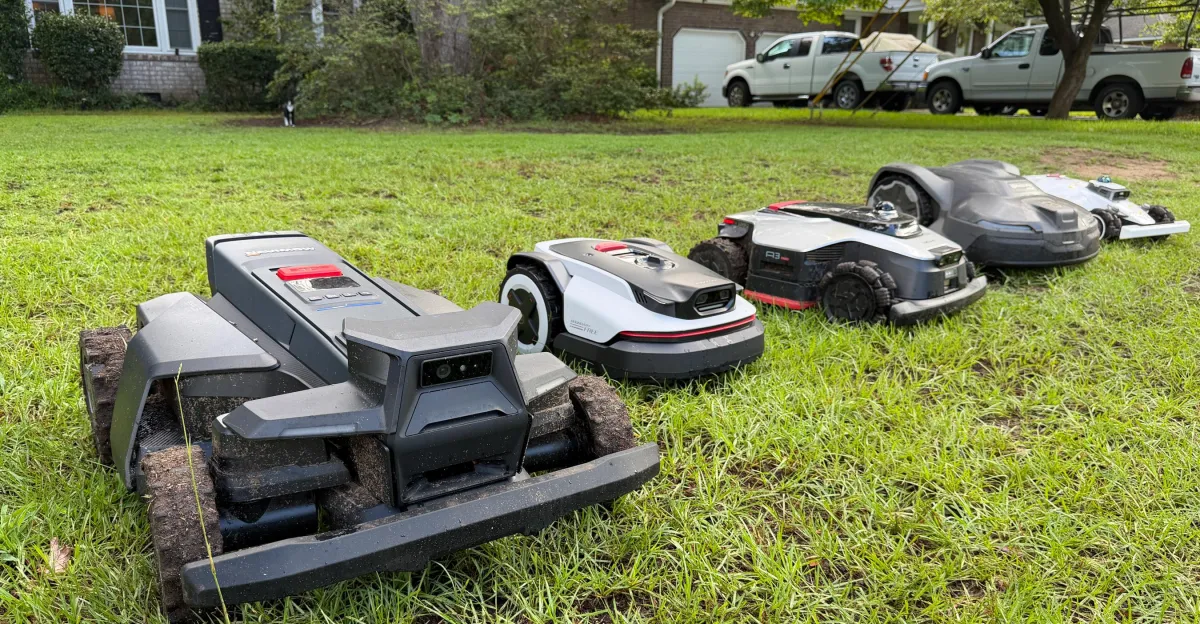
From left, Segway, Roborock, Dreame, Husqvarna, and Mammotion automowers lined up to do battle with my lawn. | Photo: Jennifer Pattison Tuohy / The Verge Robot lawnmowers are finally good enough to take a lot of work out of maintaining a yard, but they’re still not set-it-and-forget-it machines. If you don’t want these autonomous cutting machines to tear up your lawn or go roaming in your neighbors’ yard, you’re still going to need to keep an eye on them. But with some oversight, they can take a big chore off your hands. This summer I tested five bots on my flat, three-quarter-acre, coastal South Carolina property with sandy soil, centipede grass, and lots of trees. Things went much better than last year’s trials and tribulations , thanks to huge improvements in navigation and maneuverability. Basically, they stopped getting stuck. My lawn has never looked better, and my spouse — who had sworn off robot lawnmowers after a user-error injury — is now a convert. His riding lawnmower has been idle for over a month. The consistency of robot mowers is impressive. Running daily and shaving just millimeters at a time, these mowers have created a noticeably lusher lawn. I walked out on it barefoot this morning — something I’ve never done before. The best part is that they work quietly around the clock, without bothering my pets, the wildlife, or the neighbors. I also love the professional-looking lawn lines they make. What’s better The key upgrades this year are network RTK navigation , fallback navigation systems, and improved all-wheel-drive to tackle rougher terrain. RTK — real-time kinematic positioning — is the satellite positioning tech most automowers switched to over the last few years as they’ve ditched boundary wires. It uses stationary ground-based reference stations (antennas), along with GPS, to provide very precise location data, down to a centimeter or two. It’s used for surveying, drone navigation, and anything that needs that fine level of precision. Every mower I tested, apart from the Lidar-based Dreame, comes with its own RTK antenna that needs to be installed in your yard with a clear view of the sky; trees, a neighbor’s house, or your own roofline can all block the signal. In my previous testing, I didn’t get a single RTK mower to run successfully in my backyard, where I have very spotty GPS coverage. This new crop all now offers NetRTK as an option. This taps into a network of existing RTK reference stations through a cloud connection, and requires a Wi-Fi or 4G connection on the mower. Most worked out of the box without me needing to install the antenna, but you’ll need to check if your house is covered, as coverage varies . RTK mowers now also use a secondary navigation tech such as lidar or vSLAM to keep on track when the signal drops. This improvement in navigation, plus bigger, more capable machines, meant I no longer spent my summer dragging confused mowers out from under oak trees. What still needs work However, automowers are far from perfect. These are autonomous machines with blades, and leaving them to their own devices comes with risks. One spent three days methodically destroying a patch of my lawn before I noticed. Another took out two outdoor extension cords. Several models dug sandpits in bare patches, and another tried to climb up a small tree. Obstacle detection is better across the board, but it still has a long way to go. Hoses, cables, and cars are still a challenge — my family now knows to check under the wheels before driving away. No one has really solved gates yet, either (although they’re trying ) — I still have to manually open mine to let the robot mow the full property. And, while every manufacturer currently advertises NetRTK coverage as free for the lifetime of the device, there are obvious downsides to relying on a cloud service to mow your lawn. Finally, automowers are still expensive, and I have concerns around long-term durability. Like their siblings, robot vacuums, there are myriad models on the market now; the right one for you will depend on the size of your yard and your landscape. To find the mower that worked best for me, I tested four top-of-the-line models with specs capable of tackling my challenging terrain and large expanse of my backyard: The Husqvarna 420 IQ ($3,299), Mammotion Luba 3 AWD 3000 ($2,799), Navimow X430 ($2,499), and the Dreame A3 AWD Pro 2500 ($3,099.99). I also tried the entry-level Roborock RockNeo Q110H ($1,299) on my front lawn, which is more like a standard suburban lawn. Also like robot vacuums, robot lawnmowers fall under the new FCC robot ban , so while existing models can continue to be sold and supported in the US — including all the models reviewed here — the fate of new models is in question. The robot I’d get for my yard Segway Navimow X430 Navigation : RTK, vSLAM / Yard size : up to 1 acre / Cutting : 0.75” to 4” height, 17” width (dual discs) / Terrain capabilities : 4WD, zero-turn wheels, 84% slope / Theft features : Lift and out-of-zone alarms, GPS anti-theft, PIN / Weatherproofing : IP67 / Connectivity : 4G (1 yr free then $32.90 a yr), Wi-Fi, BLE / Warranty : 3 yrs Where to Buy: $2499 at Amazon $2499 at The Home Depot $2499 at Segway The Segway Navimow X430 ($2,499) is by far the best mower I tested. This 60-pound beast looks like Darth Vader’s dog, and was the only mower I tested that didn’t get stuck once. Its 4WD wheels combined with impressive suspension rolled through the potholes, over sticks and rocks, even small tree branches. It navigated around my chickens and across the tall, uneven transition from my front yard to back yards — it was the only bot that could mow both in one trip (with the gate open). This video shows the Segway tackling a sandpit and executing a 90-degree turn without damaging the sod. It uses a combination of RTK, vSLAM, and vision-based tech to navigate, and it covered my entire property without once getting lost or stuck. It features impressive “xero-turn” maneuverability enabling it to pivot smoothly with no lawn damage. Its dual-disc, 17-inch cutting width covers more ground, and it was able to mow most of my backyard in under three hours — nearly twice as fast as most competitors. I really liked the remote-control mowing feature, which was handy for tidying up the edges of the lawn and more sensitive areas such as around flower beds. The Segway’s speed does mean a few blades go untrimmed, and its rain sensing relies on weather data from the internet, which meant it often didn’t mow because it predicted rain that never came. Setting up the NetRTK was a bit tricky, mostly because I had to put the charging station in an awkward spot to connect to the GPS (it can’t be under an awning or up against a building as the mower also needs a clear view of the sky). A good lidar-based alternative Dreame A3 AWD Pro 2500 Navigation : Lidar, AI vision (camera-based) / Yard size : 0.62 acre / Cutting : 1.2” to 3.9” height, 15.8” width (dual discs) / Terrain capabilities : AWD, zero-turn wheels, 80% slope / Theft features : Lift and out-of zone alarms, GPS anti-theft, PIN / Weatherproofing : IPX6 / Connectivity : 4G (3 yrs free), Wi-Fi, BLE / Warranty : 2 yrs Where to Buy: $3099.99 $2499.99 at Amazon $3099.99 $2499.99 at Dreame The Dreame A3 AWD Pro 2500 ($3,099.99) is the best option if you can’t rely on RTK. Its lidar and camera-based navigation performed nearly as well as the Segway in my backyard, only getting stuck a couple of times. It doesn’t need a clear view of the sky, so you can place it anywhere, and its sliding edge-cutting deck worked slightly better than the Segway’s EdgeSense feature in my testing. (Beware, it’s set to a fixed 1.2-inch minimum). But in my testing, lidar was the least reliable navigation tech, and sometimes the A3 declared the job complete when it wasn’t. Lidar robots do best in a fenced-in yard, as they can more easily get lost and wander off into your neighbors’ yard, something that never happened with th
فتح الخبر الأصلي