ميسومي أمريكا تصدر تقرير إعادة الإنتاج
ميسومي أمريكا تصدر تقرير إعادة الإنتاج،دعم قانون التدريب الصناعي
لماذا يهم هذا الخبر؟
الreshoring من الإنتاج إلى الولايات المتحدة يُعَدّل بسبب نقص العمال والرغبة في الاستقلالية الصناعية الوطنية.
سياق الخبر
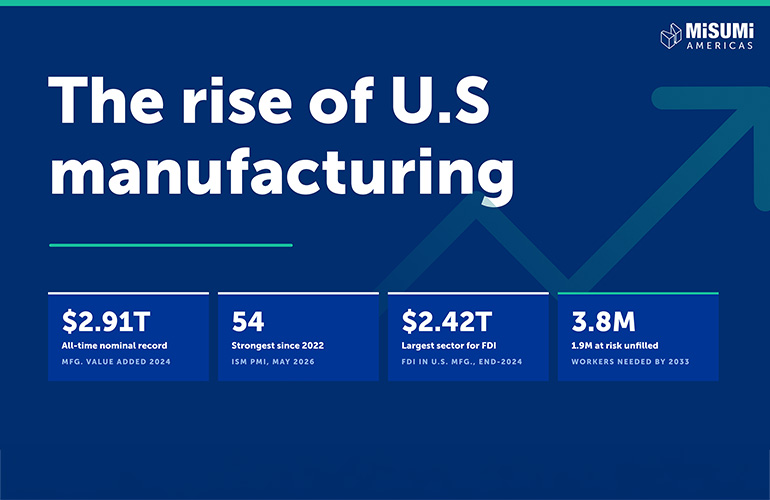
U.S. manufacturing reached a record $2.91 trillion in value. Source: MISUMI Americas Labor shortages and a desire for national self-reliance are driving reshoring of production to the U.S. But how much reshoring is actually happening? MISUMI Americas today released its report on The Rise of U.S. Manufacturing , which has compiled mostly positive statistics. Demographics is driving investment automation, as manufacturers struggle to mitigate the growing workforce challenge. The industry will need 3.8 million more workers by 2033, and 1.9 million of those positions could go unfilled, according to The Manufacturing Institute and Deloitte. Of that 3.8 million, about 2.8 million comes from workers retiring and the remainder from new growth, including jobs tied directly to the CHIPS Act, the Inflation Reduction Act, and the Infrastructure Investment and Jobs Act. More than 65% of manufacturers have cited attracting and retaining talent as their single biggest business challenge. Investment in U.S. manufacturing grows At the same time, U.S. manufacturing value added hit a record $2.91 trillion in 2024, reported MISUMI Americas. The Institute for Supply Chain Management’s purchasing managers’ index ( ISM PMI ) reached 54 in May 2026, its strongest reading since 2022. Factory construction spending peaked at $235.6 billion in 2024, nearly triple the roughly $81.9 billion spent in 2021, found the U.S. Census Bureau. Semiconductor fabs and electric vehicle (EV) battery plants, fueled by the CHIPS Act and Inflation Reduction Act, drove the majority of that increase. That pace has since moderated to about $196 billion by January 2026. In addition, f oreign companies have committed $2.42 trillion to U.S. manufacturing, said the Bureau of Economic Analysis ( BEA ) and the World Bank. Manufacturing is now the single largest sector for foreign direct investment (FDI) in the country, representing more than 42% of all FDI in the U.S. Misumi noted that Japan accounted for over $819 billion of that total, more than any other country investing in a U.S. industry. If U.S. manufacturing was its own economy, the sector would be the eighth largest in the world. Source: MISUMI Americas Vocational enrollments rise as labor demand becomes acute Since 2010, reshoring and FDI have produced more than 2 million jobs since 2010 , said the Reshoring Initiative. In 2024, 88% of those jobs were in sectors such as semiconductors, electronics, and EVs. Approximately 1.7 million of those announced jobs have already been filled. Since Spring 2020, enrollment at vocational community colleges has grown by 20%, estimated the National Student Clearinghouse Research Center. Undergraduate certificate programs have grown for four consecutive years, but total enrollment remains under 1 million students nationwide, a fraction of the number of people that manufacturers will need by 2033, Misumi acknowledged. “The investment case for American manufacturing has never been stronger — record output, a historic construction cycle, trillions in committed foreign capital,” stated Dave Evans, president and CEO of MISUMI Americas and CEO of Fictiv . “What we see with our customers every day is that the next constraint isn’t capital. It’s having enough people with the right advanced skills to run these new facilities at full capacity. The good news is that American students are already moving toward skilled trades and technical training.” Manufacturing will need millions of workers by 2033, with nearly half of those jobs at risk of going unfilled. Source: MISUMI Americas MISUMI Americas endorses training bill In addition to its release, MISUMI Americas has endorsed H.R. 9097, the American Manufacturing Revitalization Exchange Program Act , introduced by Rep. Bill Huizenga (R-MI) and now pending before the House Committee on Foreign Affairs. The bill would provide a stipend to send American workers to allied nations for six to 12 months of hands-on training in advanced production skills for industry-recognized credentials. “H.R. 9097 builds directly on that momentum by sending workers to learn from the countries — Japan, Germany, South Korea — that have spent decades perfecting advanced manufacturing training, and bringing that expertise home,” said Evans. Supporters of the proposed legislation include the National Association of Manufacturers, the Manufacturing Institute, United Steelworkers, IEEE-USA, BMW Group , the American Automotive Policy Council, LIFT, the Alliance for International Exchange, Automation Alley, and the Additive Manufacturing Coalition. MISUMI Americas discusses its report Andy Sherman , senior vice president for operations and supply chain at MISUMI Americas, answered the following questions from The Robot Report about the company ‘s findings and H.R. 9097: How much of the recent reshoring was expansion of existing operations versus new construction? Andy Sherman, MISUMI Americas Sherman: The Reshoring Initiative data we cite includes announced U.S. manufacturing jobs from two streams — reshoring by American-headquartered companies and foreign direct investment. In 2024, that split ran about 66% reshoring to 34% FDI, the widest margin favoring domestic reshoring on record. What that source doesn’t cleanly separate is construction versus expansion of existing plants; a single announcement often blends both. Where you can see that breakdown is in BEA’s foreign-investment data, and it’s revealing: Of the $232.2 billion in new FDI in 2025, the overwhelming majority was acquisitions of existing businesses, with only $4.6 billion for brand-new establishments and $9.2 billion for expansions. So the honest picture is that a large share of the capital flows through existing operations rather than pure new construction — which is exactly why the workforce question is so critical right now. And why MISUMI Americas is investing so heavily in our educational partnerships starting in middle school through to graduate studies. U.S. manufacturing PMI in May reached its strongest level in four years, signaling renewed growth in orders, production, and backlogs. Source: MISUMI Americas Are there demographic factors beyond student numbers — like generational preferences — driving the shortage? Sherman: The generation actually reshaping the floor today is Gen Z, with Millennials in the supervisory ranks. The pattern we watch most closely is retention. Gen Z workers change jobs roughly every 2.3 years, far faster than prior generations, and manufacturing turnover has topped 40% annually in some settings, with high turnover now among the top reasons companies miss production targets. What that generation is asking for is well documented: purpose, financial security, well-being, and clear opportunities to learn and grow — not just a paycheck. The encouraging counter-trend is that a meaningful share of young people are now choosing trade and vocational training over a traditional four-year path. Our job as an industry is to convert that openness into long careers, and that’s a systems design problem — how the work feels, what it pays, whether there’s a visible ladder — not just a recruiting problem. If foreign investment declined from 2022 to 2023, what are the latest trends? Sherman: In 2025, new FDI jumped 49.5% to $232.2 billion, with manufacturing leading all sectors at $121.8 billion — 52.5% of the total. Notably, Japan was the single largest source country at $50.5 billion. Manufacturing’s share of inbound investment strengthened even as the headline number moved around, which fits what we see in our own business. It’s worth separating flow from stock, too. The cumulative FDI position in the U.S. reached $5.71 trillion at the end of 2024, with manufacturing affiliates posting the largest increase — that long-term accumulation is the $2.4 trillion figure people often quote. More than 2 million U.S. jobs have been announced since 2010—most in advanced manufacturing. Source: MISUMI Americas. If community co
فتح الخبر الأصلي