NVIDIA shares how to evaluate general-purpose robot policies for real-world deployment
RoboLab research powers NVIDIA Isaac Lab-Arena, an open-source simulation framework for large-scale policy setup and evaluation. The post NVIDIA shares how to evaluate general-purpose robot policies for real-world deployment appeared first on The Robot Report .
لماذا يهم هذا الخبر؟
سيظهر الملخص التحليلي هنا بعد اكتمال معالجة الذكاء الاصطناعي.
سياق الخبر
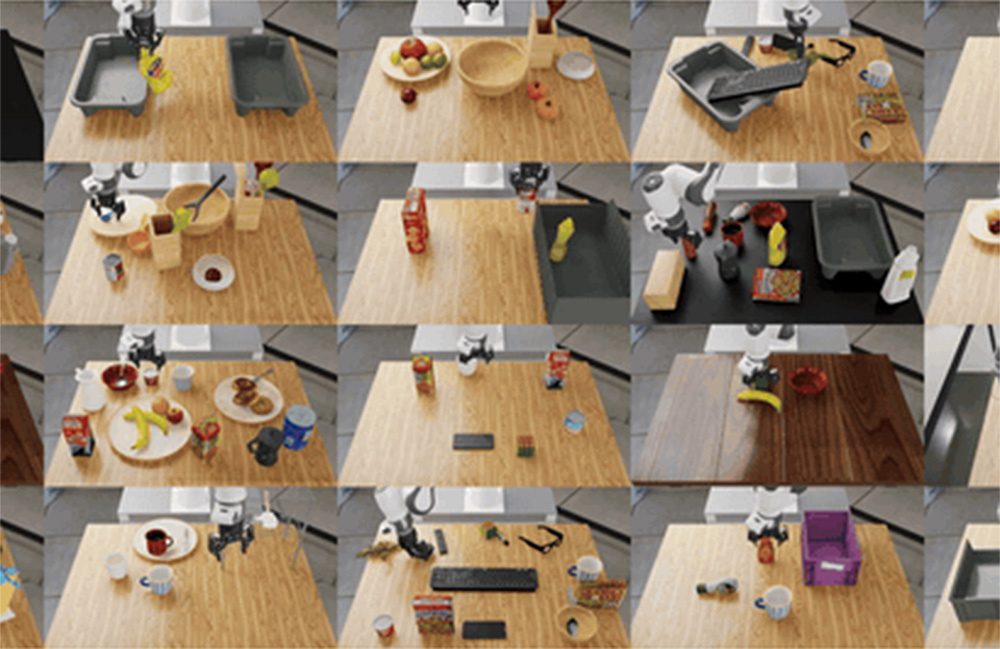
RoboLab is NVIDIA’s simulation benchmarking platform. | Source: NVIDIA Robotics foundation models have made remarkable progress, according to NVIDIA. Today’s best systems can follow natural language instructions to pick, place, sort, and manipulate a wide variety of objects. But as these models grow more capable, evaluating them rigorously has become one of the field’s hardest unsolved problems. In this blog post, we introduce the key problems and our method for addressing them. Why current benchmarks fall short Real-world testing is expensive, slow, and difficult to reproduce. For a robot’s performance in the real world to be evaluated thoroughly, we need a reasonable proxy. Simulation is the natural place to run large-scale robot evaluations. Yet most existing benchmarks share a few critical issues. Visual domain overlap in training and evaluation First, the data and environments used in policy training and evaluation are almost always drawn from the same visual source. When a model is fine-tuned on simulated data and evaluated in that same simulated environment, strong performance reveals only that the model memorized the setup, not that it can generalize. This remains a critical issue in robot evaluations, as the visual quality of simulation hasn’t achieved parity with real-world image observations. Real2sim approaches address this issue by reconstructing photorealistic environments from real-world images using techniques such as inpainting or Gaussian splatting, but per-scene setup can exceed an hour, making large-scale testing impractical. Figure 1. Existing sim benchmarks suffer from visual and task-domain overlap, low realism, and high overhead for scene and task generation. Traditional procedural scene generation often suffers from low rendering quality, creating large sim2real visual gaps. 3D reconstructed (3DR) environments bring more realism into simulated environments, but often at the cost of human effort used to generate each scene. | Source: NVIDIA NVIDIA cites benchmark saturation Second, generating tasks is a tedious endeavor. Most benchmarks have a fixed task set that is rarely updated. This quickly leads to performance saturation: Models quickly max out scores on static task sets, making it impossible to distinguish which model is genuinely more capable. When every system reports over 90% success on the same benchmark, the numbers become less meaningful. Figure 2. Almost every model paper reports results on this benchmark, but saturation makes it difficult to extract meaningful conclusions about model performance. | Source: NVIDIA Diagnostic gap There’s also a deeper diagnostic gap. A binary success/failure score doesn’t explain why a robot failed. Was it confused by the object’s color? Instruction phrasing? A shifted camera? Did it perform the task efficiently according to the specific language instruction? Without answers to these questions, researchers have little to act on. Figure 3. An example evaluation episode for the task “Put the orange measuring cup and the blue measuring cup outside of the plate” with Policy pi0.5. | Source: NVIDIA Statistical trustworthiness Every physics engine and policy is subject to some stochasticity. A single success rate on N rollouts tells you almost nothing about how confident you should be in a policy’s true performance. If a policy succeeds nine out of 10 times, is it a “90% success” policy, or could it just as easily be an 80% or 95% policy that got lucky on a small sample? To investigate this, we look at the Clopper-Pearson method. Figure 4. Clopper-Pearson Interval is a method for bounding a binomial success rate. | Source: NVIDIA The Clopper-Pearson method is an “exact” method for constructing a binomial confidence interval around the success rate, computed directly from the binomial distribution. Let’s look at the following example: For an observed 90% success rate with just 70 rollouts, a 95% Clopper-Pearson confidence interval spans a full 15.4 percentage points (80.5% to 95.9% success rate). With 1,030 rollouts, this error tightens to a ±2 percentage-point band (88.0% to 91.8% success rate). Most published benchmarks do not run a sufficient number of rollouts to achieve statistical significance when comparing the performance of two policies. Figure 5. A 95% Clopper-Pearson interval for a success rate of 90%, with blue dashes illustrating the CP interval around 90%. Narrowing the confidence interval from 10 to 2 percentage points requires roughly 15x more rollouts (70 to 1,030). | Source: NVIDIA NVIDIA introduces RoboLab NVIDIA has built a simulation benchmarking platform called RoboLab to address these issues. RoboLab is built around three principles: Enable robot-agnostic evaluations of the tasks while providing meaningful metrics Enable rapid generation of new tasks to avoid benchmark saturation, with support for agentic AI workflows Provide a full suite of analysis tools that paint a full picture of how well a policy is doing, when it fails, and why it fails. Figure 6. Benchmarks need to adapt to new capabilities as the field evolves. Once the existing benchmark performance saturates, it’s time to adapt and expand the benchmark. | Source: NVIDIA Robot benchmarking in the age of agentic AI Figure 7. RoboLab’s 3-step scene, task, and environment generation process. | Source: NVIDIA RoboLab mirrors a real-world setup procedure: place objects, add a language instruction, and run a policy. Given a library of objects, users can simply place the objects in the scene and specify a language instruction — or three! — for the task, with the whole process taking only minutes. RoboLab also comes with agent skills that a coding agent can use to generate novel tasks directly in a user’s workflow. This efficiency also future-proofs the benchmark: New tasks can be added and outdated ones retired as generalist models improve. Bring your own robot Building a generalist robot policy requires solving a long tail of specific tasks, and no single team has abundant data across every embodiment. A lab might have thousands of hours on a Franka arm but almost none on a humanoid , or vice versa. A benchmark tied to one specific robot forces every user into that same data gap, regardless of what they’re actually trying to build or test. RoboLab tasks are robot- and policy-agnostic, meaning the same set of tasks can be evaluated regardless of robot embodiment or policy architecture. Users are free to make their own design choices; RoboLab simply compiles the same scenes and tasks against whichever robot they bring. This also makes sense as the number of robot embodiment choices increases in the future; it matters less which robot was used for data generation and training, only that it solved the task. Capability-specific tasks A useful benchmark needs to isolate distinct capabilities, not just measure whether a robot completes a task. We have observed that general-purpose manipulation draws on at least three separate competencies: Visual competency tests whether a policy can recognize and act on perceptual attributes like color, size, and semantic category, such as distinguishing the small red cup from other objects on the table. Procedural competency evaluates action-oriented reasoning: stacking objects, reorienting them, or inferring how to interact with a tool. Relational competency probes spatial and linguistic logic, including conjunctions (“pick the orange and the lime”), counting, and relative positions like left of or inside. By designing tasks that each target one or more specific capabilities, we can ensure broad coverage across the full space of skills a general-purpose policy needs. In RoboLab-120, our initial benchmark of 120 human-curated tabletop pick-and-place tasks, each task is tagged with the multiple capabilities it requires, so the benchmark’s coverage across competencies remains explicit and balanced, and adjusted as new tasks are added. Competency What It Tests Example Task Visual Colo
فتح الخبر الأصلي